
What if the real value of a $10,000 SUV isn't the price on the window, but the data on a technician's digital report? It's natural to feel a knot in your stomach when shopping for budget-friendly transportation. You're likely worried about buying a "lemon" or getting lost in a sea of technical jargon you don't understand. We agree that nobody should have to guess whether their car will start tomorrow morning. The dealership inspection process for used cars is the essential filter that separates reliable daily drivers from expensive headaches.
This behind-the-scenes guide pulls back the curtain so you can buy your next vehicle with total confidence. We'll explain the rigorous mechanical vetting process that professional dealerships use to catch issues before they ever reach the lot. You'll learn which specific documents to ask for, from vehicle history reports to multi-point inspection checklists. We're going to break down everything from tire tread depth requirements to brake pad standards. You'll leave this article knowing exactly how to secure a reliable $10,000 investment while avoiding the usual anxiety of the used car market.
Key Takeaways
- Learn the difference between a basic state safety test and the comprehensive dealership inspection process for used cars that ensures long-term reliability.
- Identify why powertrain and undercarriage checks are critical for vehicles in the St. Louis area to prevent issues caused by winter road conditions.
- Understand how to prioritize mechanical safety standards, such as brake and tire health, over minor cosmetic imperfections that don't affect performance.
- Discover how to cross-reference a dealership's multi-point checklist with vehicle history reports to verify the true condition of your next SUV or truck.
- See how budget-friendly vehicles under $10,000 can still offer peace of mind when they undergo a professional vetting process before hitting the lot.
Why the Dealership Inspection Process Matters for Used Cars
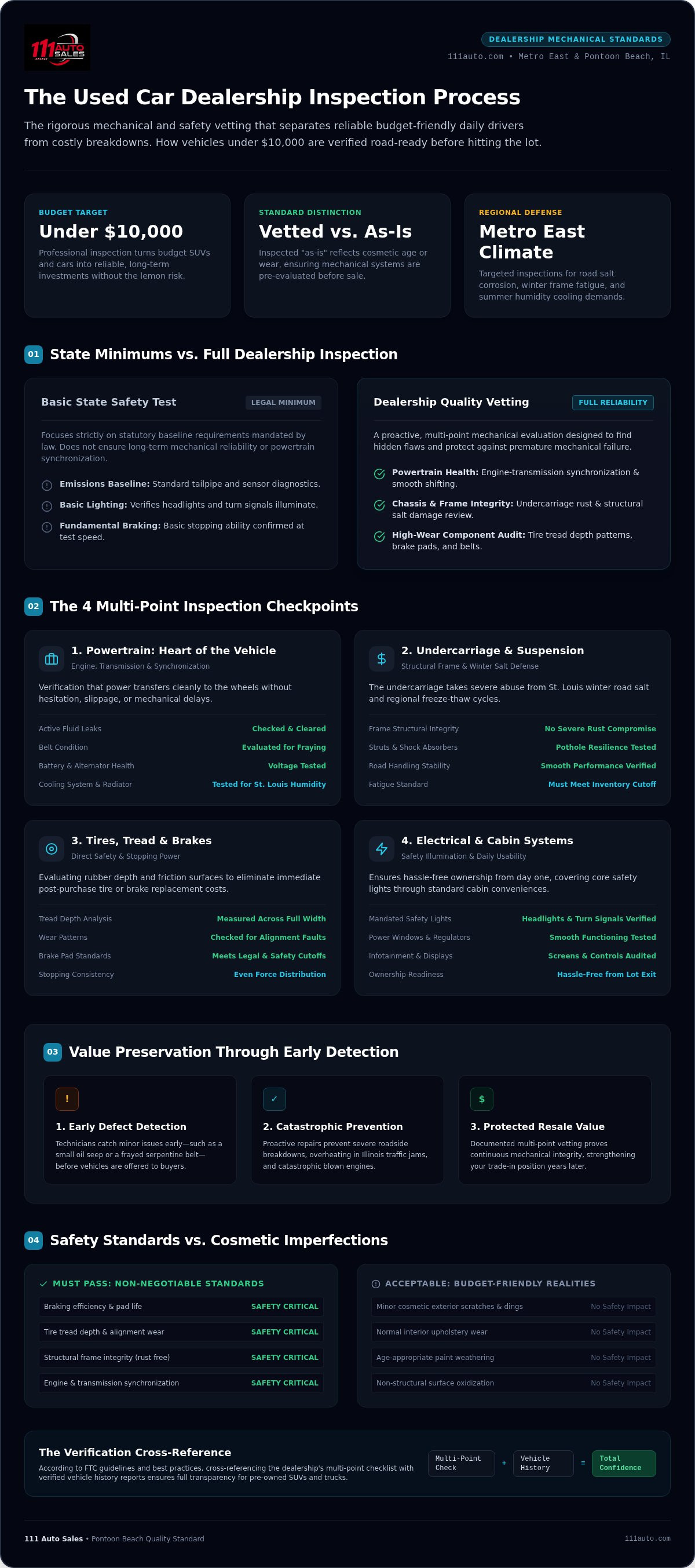
A professional dealership inspection isn't just a quick walk-around or a fresh coat of wax. It's a rigorous, multi-point mechanical and safety vetting process designed to identify hidden flaws before a vehicle ever reaches the sales lot. While many buyers assume a car is ready to drive just because it's for sale, the dealership inspection process for used cars serves as the final line of defense against mechanical failure. This is especially vital when searching for used cars under 10000 Pontoon Beach, where buyers need maximum reliability from a budget-friendly investment.
Many drivers confuse a state-mandated safety test with a dealership’s quality inspection. A state test typically covers the bare legal minimums, focusing on emissions, basic lighting, and fundamental braking. In contrast, a quality dealership vetting adheres to broader vehicle inspection standards that evaluate the engine's health, transmission smoothness, and suspension integrity. Our goal is ensuring every vehicle is road-ready for the unique challenges of the Metro East climate, where humidity and road salt can take a heavy toll on older components.
The Difference Between 'As-Is' and 'Inspected'
It's a common misconception that an "as-is" sticker means a car hasn't been checked. At a reputable dealership, every vehicle undergoes a thorough review to reduce the risk of immediate post-purchase repairs. Illinois law requires certain basic safety components to function, including headlights, turn signals, and brakes. However, an inspected vehicle goes further. By identifying worn parts early, we ensure that the "as-is" status reflects a car's cosmetic condition or age rather than a pending mechanical disaster. This transparency builds the trust necessary for a confident purchase.
Value Preservation Through Early Detection
Catching a small oil leak or a frayed belt today prevents a blown engine or a roadside breakdown tomorrow. These inspections are proactive. A clean, documented inspection report doesn't just provide peace of mind; it preserves your vehicle's future resale value. When you can prove a car was professionally vetted and maintained, you're in a much stronger position when it's time to trade it in. Dealerships invest in these comprehensive checks because our local reputation in the Pontoon Beach area depends on the long-term performance of the cars we sell. We prioritize mechanical integrity to keep you on the road safely.
A comprehensive multi-point inspection is the backbone of transparency in the pre-owned market. While some national retailers suggest these checks are reserved for high-end certified models, a reliable independent dealer uses the dealership inspection process for used cars to vet every vehicle on the lot, regardless of the price point. This systematic approach evaluates high-wear components that are often invisible to a casual buyer. According to the FTC guide on buying a used car from a dealer, understanding these disclosures and the results of a mechanical inspection is crucial for protecting your investment.Under the Hood: The Heart of the Vehicle
A powertrain check is the verification of the engine and transmission’s synchronization to ensure power reaches the wheels without hesitation. Technicians look for active fluid leaks, excessive belt wear, and battery health to prevent unexpected breakdowns. In our region, the cooling system must be in top shape to handle the heavy Illinois summer humidity. We check coolant levels and radiator efficiency to ensure your SUV or truck doesn't overheat during a St. Louis traffic jam.
Beyond the engine, the electrical systems undergo rigorous testing. This includes everything from basic safety equipment like headlights and turn signals to modern infotainment screens and power windows. Even on budget-friendly vehicles, these features should function correctly to ensure a hassle-free ownership experience from the moment you leave the lot.
Tires and Suspension: Handling the Metro East Roads
The undercarriage takes the most abuse from St. Louis area winters and road salt. Technicians inspect the frame for structural integrity and look for advanced rust that could compromise safety. Suspension components, including struts and shocks, are evaluated for their resilience against local potholes. If a vehicle doesn't handle smoothly or shows signs of suspension fatigue, it doesn't meet the standard for our inventory.
- Tire Health: We measure tread depth and look for uneven wear patterns that might suggest alignment issues.
- Braking Systems: Technicians measure pad thickness and rotor condition to ensure they meet safety thresholds.
- Wheel Alignment: Verification ensures the car tracks straight, reducing tire wear and improving fuel economy.
By focusing on these core components, we eliminate the guesswork often found in private-party sales. If you are ready to see how a vetted vehicle performs on the road, you can browse our current inventory of trucks and SUVs. This level of detail ensures your next vehicle is ready for the Metro East commute from day one.
Safety Standards vs. Cosmetic Reconditioning
A common mistake in the pre-owned market is judging a car's health by its paint. While a polished exterior is appealing, it tells you nothing about the vehicle's ability to stop in an emergency or handle a highway merge. The dealership inspection process for used cars must draw a clear line between mechanical safety and cosmetic reconditioning. Safety components, such as brakes, steering linkage, and lighting, are non-negotiable. A reliable used car might have a minor door ding or slightly worn upholstery, but it must achieve a perfect score on every safety-critical metric before it's cleared for sale.
Transparency is essential here. We believe a buyer should know exactly where their money is going. Before any vehicle is listed, technicians cross-reference the VIN with the NHTSA safety recall database to ensure no critical manufacturer defects remain unaddressed. This focus on function over form is exactly why we specialize in providing used trucks under 10000 Pontoon Beach. For a working truck, a few surface scratches are expected, but a failing water pump or a soft brake pedal is unacceptable. We prioritize the "bones" of the vehicle to ensure your investment lasts.
The Road Test: Beyond the Garage
Static inspections on a lift only tell half the story. A true vetting process requires a comprehensive road test to verify real-world performance under load. Technicians monitor how the transmission shifts during both gradual acceleration and sudden stops. They listen for unusual humming from wheel bearings or vibrations that only appear at highway speeds. We also perform "cold starts" to ensure the engine turns over smoothly after sitting overnight. Checking all gauges and warning lights during the warm-up phase helps us catch intermittent electrical issues that a simple scan tool might miss.
The Detailing Process: The Final Touch
Once the mechanical integrity is verified, the vehicle moves to the detailing phase. This isn't just about making the car look new; it's a final layer of inspection. Deep cleaning the interior helps remove allergens and odors that could hide mold or past leaks. Exterior buffing and headlight restoration are particularly important for safety, as they improve nighttime visibility for the driver. A clean engine bay and undercarriage also make it much easier for technicians to spot minor fluid seeps that might develop over time. We treat detailing as the final quality control check, ensuring the car is as clean as it is mechanically sound.
How to Evaluate an Inspection Report and Vehicle History
The physical vetting of a vehicle is only half the story. To make a truly informed decision, you must understand the documentation that supports the mechanical work. The dealership inspection process for used cars culminates in a written report that should be open for your review. This document isn't just internal paperwork; it's your roadmap for the vehicle’s future maintenance and overall health. By comparing the inspection results with a vehicle history report, you can verify that the car has been treated well throughout its life.
Red flags often hide in the data rather than under the hood. Inconsistent mileage readings, multiple recent owners in a short period, or "branded" titles indicating past salvage history are all reasons to pause. A reputable dealer will provide these reports upfront to show they've nothing to hide. This transparency is the only way to ensure you're making a secure investment in the Metro East market.
Decoding the Checklist
Most professional inspection reports use a standard color-coded system to communicate the vehicle’s condition. Understanding these categories helps you plan for future costs:
- Green Status: The component meets or exceeds all safety and performance standards. No immediate action is needed.
- Yellow Status: The part is currently functional but shows signs of wear. These are "wear items" like brake pads or tires that will likely need attention within the next six months or 5,000 miles.
- Red Status: The component failed the inspection and required immediate repair or replacement before the vehicle was cleared for the lot.
Always verify that the VIN on the report matches the vehicle you're testing. If you see a lot of "Yellow" items, use that information to budget for upcoming maintenance. If you're ready to see a transparent report for yourself, you can view our inspected inventory online to start your search.
Integrating History with Current Condition
A documented service history validates a clean inspection report. If the history shows regular oil changes and belt replacements, it gives weight to the technician's current "Green" rating. You can also use the history report to ask specific questions. If you notice a vehicle spent several years in a salt-heavy climate, you should ask if the brake lines and undercarriage were specifically checked for corrosion during the intake process.
Even a perfect history and a clean inspection cannot predict every future mechanical event. This is why used truck warranty Pontoon Beach options are so popular. A warranty adds a second layer of security, protecting your wallet from the unexpected once you drive off the lot. Combining a thorough inspection, a clean history, and a solid warranty creates the ultimate safety net for any used vehicle purchase.
111 Auto Sales: Our Local Standard for Budget Reliability
111 Auto Sales LLC operates with a specific mission: providing reliable transportation for the Metro East community at an accessible price point. While high-end franchises often reserve their best technicians for Certified Pre-Owned programs, we believe every buyer deserves transparency. The dealership inspection process for used cars at 111 Auto Sales LLC applies the same rigorous standards to our entire inventory, particularly for our specialized selection of vehicles priced under $10,000. We understand that for many families in Pontoon Beach, a budget-friendly SUV isn't just a purchase; it's a vital tool for work and daily life.
Expert Vetting for Every Budget
Our inventory focus remains on pre-owned trucks and SUVs because these vehicles are best suited for the demands of the Metro East region. Whether you're hauling equipment or commuting across the river, your vehicle needs to be mechanically sound. We prioritize core safety and powertrain integrity over superficial cosmetic details. To further protect your investment, we offer extended warranty options on our vehicles. This ensures that even after you drive off the lot, you have a safety net against future repairs. We bridge the gap between high-mileage budget pricing and mechanical confidence through verifiable history checks and multi-point safety vetting.
Your Local Partner in Pontoon Beach
Being a local independent dealer means our reputation is tied to every car we sell in Granite City and Collinsville. We don't hide behind corporate jargon. Instead, we invite every customer to review the full inspection report before signing any paperwork. This commitment to transparency is why our dealership inspection process for used cars at 111 Auto Sales LLC is so detailed. We want you to see the exact condition of the brakes, tires, and suspension systems. Our team lives and works in the same community as our customers, so we treat every inspection as if we were vetting a car for a neighbor.
We also recognize that a reliable car requires a realistic payment plan. There is a direct synergy between our mechanical vetting and our used SUV financing Pontoon Beach programs. When a vehicle is properly inspected and reliable, it represents a lower risk, which helps us secure competitive financing options for you. By combining mechanical confidence with accessible financing, we remove the barriers to owning a quality vehicle. Visit us on Route 111 to review a vehicle's history and inspection report today.
Drive With Confidence in the Metro East
Buying a pre-owned vehicle shouldn't feel like a gamble. When you understand the dealership inspection process for used cars, you gain the power to look past the paint and focus on mechanical integrity. A thorough vetting process ensures that even budget-friendly transportation meets strict safety and performance standards. By reviewing multi-point checklists and cross-referencing vehicle history reports, you're protecting your investment and your family on the road.
111 Auto Sales is your local partner for transparency. We specialize in providing reliable trucks and SUVs under $10,000 for the Pontoon Beach and greater Metro East community. To ensure your long-term satisfaction, we offer extended warranties for all our inventory. You're invited to see the results of our vetting process for yourself and find a vehicle that fits your needs and your budget. Our team is ready to help you navigate the technical details so you can make an informed choice.
Browse Our Inspected Inventory at 111 Auto Sales and start your next journey with total peace of mind.
Frequently Asked Questions
What is included in a standard multi-point inspection for a used car?
A standard multi-point inspection covers the powertrain, braking system, suspension, and electrical components. Technicians check fluid clarity in the engine and transmission, measure brake pad thickness, and evaluate tire tread depth. They also test safety features like headlights, turn signals, and wipers. This comprehensive dealership inspection process for used cars ensures that every major system is functional and safe for daily driving on Metro East roads before the vehicle is listed for sale.
Can I request a copy of the dealership's inspection report before buying?
You absolutely can and should request a copy of the inspection report before making a purchase. Reputable dealers in the Pontoon Beach area, like 111 Auto Sales, provide these documents to build trust and demonstrate transparency. Reviewing the report allows you to see which components were recently serviced and which wear items might need attention soon. If a dealer refuses to show you their internal vetting results, it's a major red flag.
Is a dealership inspection as good as a third-party pre-purchase inspection (PPI)?
A dealership inspection is a rigorous internal vetting process, while a third-party PPI provides an outside perspective. Dealerships use their inspections to decide which cars are reliable enough to sell to the local community. While a dealership report is highly detailed, we always encourage buyers to seek an independent mechanic's opinion if it helps them feel more secure. Both steps work together to ensure your investment in a truck or SUV is a sound one.
Does a 'passed' inspection mean the car won't have issues in the future?
A passed inspection confirms the vehicle is safe and mechanically sound at the moment of sale, but it isn't a guarantee against future wear. Mechanical parts can fail over time due to age or driving conditions. To account for this, we recommend protecting your purchase with one of our extended warranty packages. These plans provide a second layer of security that covers unexpected repairs long after the initial dealership inspection process for used cars is complete.
What are the most common things cars fail on during a dealership inspection?
The most common failure points include worn brake pads, shallow tire tread, and suspension components damaged by local potholes. In the St. Louis and Granite City area, road salt also causes significant undercarriage corrosion that can lead to failed safety checks. Technicians often find minor fluid leaks or aging batteries that must be replaced. Identifying these issues during the intake phase allows the dealership to address them before the car is offered to a customer.
How long does a professional dealership inspection typically take?
A professional dealership inspection typically takes between one and three hours to complete. This timeframe allows a technician to perform a static check on the lift, a computer diagnostic scan, and a real-world road test. More complex vehicles or those with advanced safety features might take longer to vet properly. This dedicated time ensures that every system, from the transmission synchronization to the infotainment screen, is functioning exactly as it should for the next owner.
Do dealerships inspect cars priced under $10,000 as thoroughly as expensive ones?
At 111 Auto Sales, we apply the same mechanical safety standards to every vehicle regardless of its sticker price. We specialize in reliable inventory under $10,000, and these cars undergo the same dealership inspection process for used cars as more expensive models. While a budget-friendly sedan or SUV might have minor cosmetic wear, it must be mechanically sound. We prioritize the safety of our neighbors in Collinsville and Maryville above all else.
What happens if a used car fails the dealership's safety inspection?
If a vehicle fails a safety inspection, it must be repaired to meet our standards before it reaches the lot. If repair costs exceed the vehicle's value, the car is sent to a wholesale auction rather than being sold to a local customer. We don't sell cars with known structural defects. This policy ensures that every SUV, truck, or van we offer to the Pontoon Beach community is truly road-ready.


