
The lowest advertised payment can make a used car look affordable while increasing what you pay over the life of the loan. That’s why used car finance rates deserve a closer look than a headline offer or monthly figure alone. The rate you’re offered may differ from the advertised rate after a lender reviews your application and the vehicle you plan to finance.
It’s reasonable to focus on a payment that fits your budget, especially when you have a set amount to spend on a vehicle. But the interest rate, APR, loan term, and total repayment each show a different part of the cost. Compare them together to get a clearer picture of whether an offer works for you.
This guide explains factors that can shape your personalized rate, including your credit profile, the vehicle’s age and mileage, your down payment, and the loan term. You’ll also learn how to compare offers by APR and total repayment, not just monthly payment, and what financial and vehicle details to prepare before discussing financing. With a clearer view of the numbers, you can assess your options with greater confidence.
Key Takeaways
- Learn how APR differs from the interest rate and why APR can help you assess borrowing costs more completely.
- See how your credit profile, down payment, loan amount, and the vehicle itself may shape used car finance rates.
- Compare offers on consistent terms by looking beyond the monthly payment to APR, fees, and total repayment.
- Prepare for a financing discussion by setting a budget, reviewing your credit information, and accounting for ongoing ownership costs.
- Explore how vehicle choice, budget, and financing options can be considered together at 111 Auto in Pontoon Beach.
Used car finance rates: what do APR and interest rate actually mean?
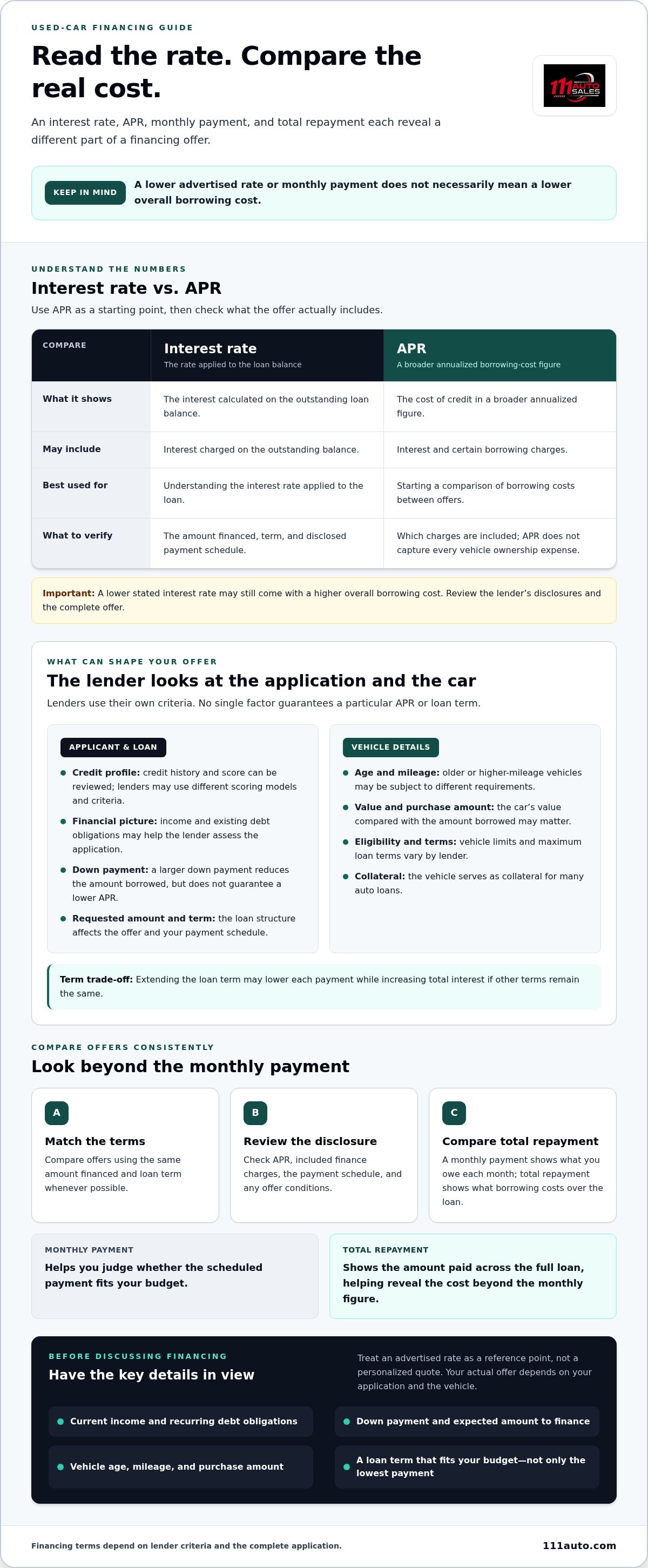
Used car finance rates describe the borrowing cost applied when you finance a pre-owned vehicle. Two figures often appear in an offer: the interest rate and the annual percentage rate, or APR. The interest rate is applied to the outstanding loan balance to calculate interest. APR is a broader annualized figure intended to help show the cost of credit and may include certain borrowing charges in addition to interest.
That difference matters because an offer with a lower stated interest rate may not have the lowest overall borrowing cost. APR can support a more useful comparison, but it doesn’t account for every expense associated with buying and owning a vehicle. Review the lender’s disclosures to see which charges are included, how much you’ll finance, and how long you’ll make payments. For additional background, see Understanding Annual Percentage Rate (APR).
“A monthly payment shows what you owe each month; the full repayment shows what borrowing the money costs over the entire loan.” Keep that distinction in mind as you review financing. A payment can look manageable because the loan runs longer, even if you pay more total interest over time.
Interest rate vs. APR: which number should you compare?
Use APR as a starting point when comparing offers, then check the details behind it. Compare offers using the same amount financed and loan term whenever possible. Read the disclosed terms for included finance charges, the payment schedule, and total repayment. If the offers differ in structure, APR alone may not show which one best fits your budget or priorities.
Why advertised used-car rates may differ from your offer
An advertised rate may be an example, a promotional offer, or a rate available only to applicants who meet stated conditions. It isn’t a promise that every buyer will receive that APR. The final offer can depend on a lender’s criteria and details in your application, such as credit history, income, existing obligations, down payment, requested loan amount, and the vehicle being financed.
Vehicle details can matter, too. A lender may consider a used car’s age, mileage, value, and requested loan terms when assessing an application. These factors can affect the rate or other terms offered. Treat a headline rate as a reference point, not a personalized quote.
When you receive an offer, compare its actual APR and disclosed terms with your budget rather than assuming the advertised figure will apply. Review the amount financed, payment schedule, and total repayment, and make sure you understand any conditions attached to the offer. With those details in hand, you can judge the financing itself, not just the most appealing number in an advertisement.
What factors shape a used car finance rate in 2026?
Your offered APR can reflect more than your credit score. Lenders may consider your credit history, income, existing debt obligations, down payment, requested amount, and details about the vehicle. These factors help a lender assess the application and the loan, but each lender weighs them according to its own criteria.
An advertised rate is not a personal approval or a guaranteed APR. Treat it as a reference point. Your actual offer depends on the details of your application and the vehicle you choose.
How credit history and loan details can affect APR
A lender may review your credit report and score to understand your borrowing history. FICO Score is a familiar scoring model, but lenders don’t all use the same model or apply identical criteria. Income and existing obligations can also help a lender assess whether the requested payments fit your financial picture. Provide accurate, current application information so a financing discussion reflects your circumstances.
Your down payment and requested loan amount matter, too. A larger down payment reduces the amount you need to borrow, which can affect the lender’s assessment, though it doesn’t guarantee a lower APR. Loan term influences the monthly payment and overall interest paid: extending the term may reduce each payment while increasing total interest if other terms remain the same. For background on how borrowing costs are disclosed, see the CFPB’s explanation of interest rate and APR.
How the used vehicle itself can influence loan terms
The vehicle is part of a lender’s assessment because it serves as collateral for many auto loans. Age, mileage, value, and purchase amount may affect the terms or eligibility offered. Older or higher-mileage vehicles can be subject to different requirements, but rules vary by lender. Don’t assume every lender sets the same vehicle limits or maximum loan term.
For example, two applicants seeking similar loan amounts might receive different terms if one is financing a newer vehicle and the other an older, higher-mileage car. The vehicle’s value compared with the amount borrowed may also be relevant. The exact effect depends on the lender’s criteria and the complete application, so consider the car and financing together rather than treating the rate as separate from the purchase.
Before discussing a specific vehicle, organize the details a lender may need:
- Current income and recurring debt obligations
- Down payment and the amount you expect to finance
- The vehicle’s age, mileage, and purchase amount
- A loan term that fits your budget, not just the lowest monthly payment
If you’re considering a sedan, SUV, truck, or van, explore used vehicles and financing options at 111 Auto in Pontoon Beach, and consider how the vehicle fits your budget.
How to compare used car finance offers beyond the monthly payment
A useful comparison starts with the same vehicle price, down payment, amount financed, and loan term wherever possible. If offers use different assumptions, a lower payment or APR may reflect a different loan structure rather than a better deal. Record the figures from each written offer, then check what you’ll pay over the full schedule.
A practical checklist for reading each loan offer
For each offer, note the APR, amount financed, term, scheduled payment, disclosed fees, and total scheduled repayment. Keep optional products and conditions separate so you can see how they affect the figures. The template below uses no assumed rates or charges. Fill it in with the actual details provided for each offer.
| Offer detail | Offer A | Offer B |
|---|---|---|
| APR | Quoted APR | Quoted APR |
| Amount financed | Same amount | Same amount |
| Loan term | Same term | Same term |
| Scheduled monthly payment | Quoted payment | Quoted payment |
| Disclosed fees | List separately | List separately |
| Total scheduled repayment | Quoted total | Quoted total |
Use identical loan amounts and terms for a fair hypothetical comparison. If offers differ, request a version using the same assumptions or account clearly for the differences. Check whether each disclosed fee is included in the amount financed or paid separately, and whether optional products change the loan amount or payment. Don’t count the same charge twice.
Why the lowest monthly payment may not be the best offer
A longer repayment period can spread payments over more time and reduce the amount due each month. But interest accrues over a longer period, which can increase the total cost of borrowing. A smaller payment may ease today’s budget while leaving you committed for longer. Compare both the monthly obligation and the complete repayment amount before deciding.
For example, imagine two hypothetical offers for the same amount financed and APR, but with different terms. The offer with the longer term may show a lower monthly payment, while its scheduled payments add up to more over the life of the loan. This illustrates a comparison principle, not a rate or savings estimate; actual figures depend on the offers.
Choose a payment that fits your budget without assuming the longest available term is best. Consider how long you expect to keep the vehicle and whether the full repayment remains reasonable. Comparing used car finance rates alongside the term, fees, and total repayment gives you a clearer basis for weighing affordability today against borrowing cost over time.
How to prepare before applying for used car financing
A few practical steps can make a financing discussion clearer and help you focus on a vehicle that fits your budget. Set a comfortable spending limit, review your credit information, compare loan terms, and then discuss financing for the vehicle you’re considering. Keep the full ownership budget in view, not just the amount you might borrow.
Set a realistic payment and total borrowing budget
Start with the monthly amount you can manage after regular expenses. Then allow for costs beyond the loan payment, including insurance, registration, taxes, maintenance, and fuel or charging. These expenses vary by vehicle and personal circumstances, so estimate them for the type of car you’re considering. A down payment may reduce how much you need to finance, but choose an amount that leaves room for other financial needs.
A car loan calculator can help you explore how the amount borrowed, APR, and term may affect an estimated payment. Use it to compare scenarios, not as a prediction of the offer you’ll receive. A calculator estimate isn’t a loan approval or a guaranteed rate. For payment planning, look for the article on how to use a car loan calculator alongside this guide.
Before settling on a payment, consider whether the full repayment and other ownership costs remain manageable. A payment that seems comfortable on its own may take up too much of your budget once insurance, maintenance, and routine operating costs are included.
Prepare credit and application information
Review your credit report before financing discussions. Check that account details and payment history appear accurate, and follow the reporting agency’s process if you find information you believe is incorrect. Lenders may use credit information as part of their assessment, so understanding what’s on your report can help you discuss your application accurately.
Requirements differ, but applicants are commonly asked for information such as identification, income, employment, residence, and existing financial obligations. Having these details organized can make it easier to provide consistent answers. Don’t assume every lender will request the same documents or use the same application process.
Be thoughtful about application timing. A formal application may involve a credit inquiry, and inquiries can appear on a credit file. The effect can depend on the scoring model and how inquiries are treated, so don’t assume every inquiry has the same impact. If you’re comparing used car finance rates, understand whether you’re viewing an estimate or submitting a full application, and keep a record of the terms offered.
Once you’ve set your budget, reviewed your credit information, and considered the loan terms, you’ll be better prepared to discuss a vehicle and its financing together. Explore used vehicles and financing options at 111 Auto in Pontoon Beach.
Explore used car financing options with 111 Auto in Pontoon Beach
Choosing a used vehicle and considering how to finance it are connected decisions. Start with your intended use and a realistic budget: think about how many passengers you typically carry, what you need to transport, and how the vehicle’s ongoing costs fit your finances. At 111 Auto Sales LLC in Pontoon Beach, you can consider vehicle choice and available financing options together, rather than viewing the loan separately from the car.
Match financing considerations to the vehicle you need
A sedan may suit everyday commuting, while an SUV can offer a different combination of passenger and cargo space. A truck or van may better fit particular work or transport needs. These are starting points, not rules. Compare the vehicle’s features and condition with your actual priorities, then consider how its purchase amount and expected ownership costs fit your budget.
111 Auto Sales LLC’s pre-owned inventory includes sedans, SUVs, trucks, and vans, with a selection priced under $10,000. As you compare body styles, consider whether a sedan or SUV better matches your needs. Keep your target payment and expected loan amount in mind as you evaluate each vehicle.
For a sedan, consider whether passenger space and daily use are your main priorities. For an SUV, think through how you’ll use its cabin and cargo area. The vehicle’s age, mileage, value, and amount financed may all be relevant to financing terms, so a rate or payment estimate detached from a specific vehicle gives only a partial picture.
Take the next step with a clear financing discussion
Before discussing financing, bring the budget and comparison notes you’ve prepared. Be ready to discuss the vehicle you’re considering, the amount you expect to finance, and the payment range that feels manageable. Reviewing those details together can help connect your vehicle choice with the financing options available through 111 Auto Sales LLC.
Actual financing terms depend on the vehicle, your application, and the financing details. No advertised example should be treated as a guarantee of approval or a personal APR. Review the terms offered for the vehicle you’re considering, including the payment schedule and total repayment, and weigh them against your budget.
Explore 111 Auto Sales LLC’s used inventory and discuss vehicle financing options in Pontoon Beach when you’re ready to take the next step.
Move forward with a plan that fits your budget
Turn your research into a clear set of priorities before choosing a vehicle. Decide which features matter most, what payment feels manageable, and which loan terms you’re comfortable considering. Then review the financing details alongside the vehicle itself. This keeps the decision grounded in your needs, not just an attractive advertised figure.
Used car finance rates are personal to the application and vehicle, so focus on the written terms for the option you’re considering. Take time to review the APR, repayment schedule, and total amount payable before making a decision. A careful comparison can help you move ahead with greater confidence.
In Pontoon Beach, 111 Auto offers pre-owned sedans, SUVs, trucks, and vans, with a selection priced under $10,000 and vehicle financing options available. Explore used vehicles and financing options at 111 Auto to find an option that fits your plans. A well-prepared next step can make the purchase feel more manageable.
Frequently Asked Questions
What is a good interest rate for a used car loan in 2026?
There isn’t one rate that’s good for every buyer in 2026. The rate you’re offered depends on factors such as your credit profile, loan details, and the vehicle. To assess an offer, compare it with other quotes for the same amount and term, then review the APR and total repayment. A rate that looks low in an advertisement may not be the rate you qualify for.
Is APR different from the interest rate on a used car loan?
Yes. The interest rate is applied to the outstanding loan balance, while APR is a broader annualized figure that may include certain borrowing costs. For a practical comparison, review both figures and the offer’s written disclosures. Check which charges are included in the APR and whether other costs are paid separately. This helps you interpret the figures accurately rather than comparing labels alone.
Can I get used car financing with a low credit score?
It may be possible, but approval and terms depend on the lender’s criteria and your complete application. A lower score can affect the APR or available loan terms, while income, existing obligations, down payment, and vehicle details may also be considered. Before applying, check your credit report for errors and decide what payment fits your budget. Don’t assume an advertised rate or approval applies to your situation.
Does the age or mileage of a used car affect financing rates?
It can affect the financing options or terms a lender considers. For example, a lender may apply different eligibility rules to an older, higher-mileage vehicle than to a newer one. Policies vary, so there isn’t one age or mileage cutoff that applies everywhere. If you’re comparing vehicles, include each car’s year and mileage in your notes and evaluate financing terms alongside the vehicle’s condition and value.
Will applying for multiple auto loans hurt my credit score?
It can, depending on whether each application triggers a hard credit inquiry and how the scoring model treats inquiries. Before submitting an application, find out whether a rate check is a soft inquiry or a hard one. Keep track of when you apply and don’t assume separate applications will be grouped together. A prequalification estimate may help you explore options, but it isn’t a final loan offer.
Can a longer loan term lower my monthly payment?
Yes, spreading repayment over more months can reduce the scheduled payment, assuming other loan details are comparable. But you’ll be borrowing for longer, which may increase the total interest paid. Check whether the payment still fits after adding ownership expenses, and weigh it against the full repayment amount. A longer term isn’t automatically the right choice; your budget and how long you expect to keep the vehicle matter.
Can I finance a used car priced under $10,000?
Financing may be available, but whether a specific vehicle qualifies depends on the lender, car, application, and loan details. Lenders can have different minimum loan amounts and vehicle requirements, so don’t assume every car can be financed on the same terms. 111 Auto offers vehicle financing options and has a selection of used vehicles priced under $10,000. Shoppers from Granite City, Collinsville, St. Louis, Belleville, Maryville, Troy, Alton, Highland, O’Fallon, Glen Carbon, Swansea, and Cahokia can explore options in Pontoon Beach.


