
Approval can feel like the biggest hurdle when you need a used car, but the loan’s total cost matters just as much. If you’re researching in-house financing used cars Troy IL, it helps to understand what the term means before comparing it with bank or credit union financing. The name alone doesn’t tell you who funds a loan or what its terms will be.
A monthly payment is important when you’re working within a budget, but consider it alongside the interest rate, repayment length, down payment, and total amount you’ll pay. Reviewing those details together can help you compare financing options more clearly.
This guide explains how in-house financing generally works, how it differs from other financing routes, and what to review when comparing loan terms. It also covers practical ways to prepare a budget and get ready to shop for a pre-owned vehicle. Located in Pontoon Beach, 111 Auto Sales LLC serves Troy and nearby communities with pre-owned sedans, SUVs, trucks, and vans, including vehicles priced under $10,000.
Key Takeaways
- Learn the difference between dealer-provided in-house financing and financing arranged through an outside lender.
- Identify who makes the lending decision, then review the written agreement for the payment schedule and your obligations.
- Use a checklist to set a realistic budget, identify vehicle needs, and prepare accurate personal and income information if requested.
- Compare in-house financing used cars Troy IL options by looking beyond the monthly payment to the full terms.
Understanding In-House Financing in Troy, IL
Financing terms can be confusing when you’re shopping for a used car. A dealership may provide financing directly or arrange a loan through another lender. The distinction matters because it determines who reviews the application, who makes the credit decision, and which agreement sets out your obligations.
In-house financing generally means the dealership provides the vehicle financing directly; dealer-arranged financing means the dealership connects the buyer with an outside lender, which makes the lending decision. The phrase Buy here, pay here financing is commonly associated with dealer-provided financing, but a label by itself doesn’t establish the structure of a particular purchase.
Financing arrangements, approval criteria, and contract terms vary. An advertisement is not a substitute for reading the written agreement. 111 Auto Sales LLC offers vehicle financing options for pre-owned vehicle purchases. Review the terms of the specific transaction to understand who provides the financing and what the agreement requires.
How in-house financing differs from a traditional auto loan
With lender-direct financing, a bank, credit union, or other lender evaluates the application and decides whether to extend credit under its terms. A dealership may help submit the application or coordinate the process, but the outside lender makes the credit decision. With dealer-provided financing, the dealership provides the financing and makes the credit decision. The contract identifies the parties and obligations for that purchase.
Neither structure guarantees faster approval or more favorable terms. The process and offer depend on the financing arrangement and the buyer’s circumstances. Compare the written terms, including the payment schedule and total repayment obligation, instead of judging an option by its name.
What Troy-area used-car shoppers should understand first
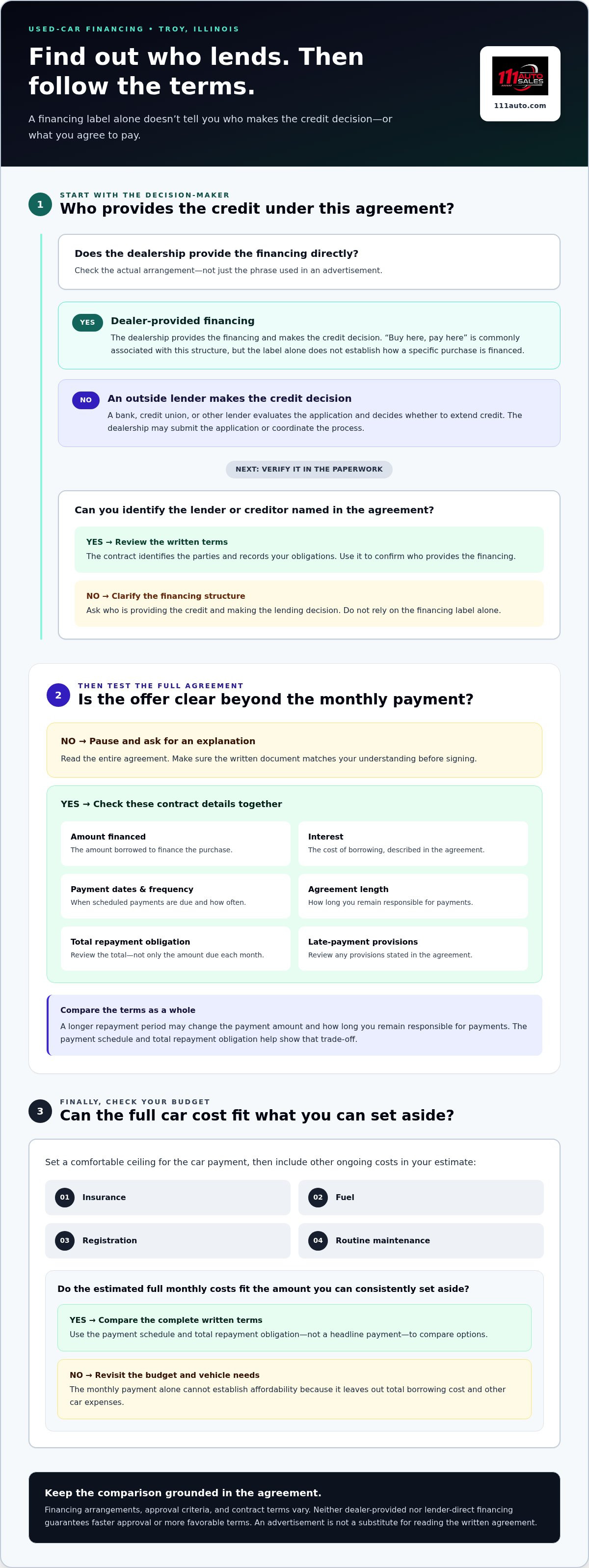
Because dealerships may use “in-house financing” differently, start with a practical question: who is providing the credit under this agreement? Find the lender or creditor named in the paperwork, then review the payment schedule and other obligations before signing. The contract records the terms you’re agreeing to.
For shoppers searching for in-house financing used cars Troy IL, this is a useful starting point for comparing offers without assuming every dealership uses the same financing structure. 111 Auto Sales LLC is located in Pontoon Beach and serves Troy and nearby Illinois communities. Its financing options are available alongside pre-owned sedans, SUVs, trucks, and vans, so you can consider vehicle needs and financing together.
How Used-Car Financing Works: Understand the Application and Agreement
Getting ready to finance a used car starts with preparing accurate information and understanding the written offer. Application steps and criteria vary by financing arrangement. Compare the offer with your budget, and take time to review the agreement before signing. Approval isn’t guaranteed, and an advertised payment doesn’t explain the full cost of borrowing.
For shoppers researching in-house financing used cars Troy IL, the key is to consider the complete obligation, not just the amount due each month. A monthly payment alone cannot establish affordability because it leaves out the loan’s total cost and the other expenses of owning a car.
Prepare a realistic vehicle and monthly budget
Before choosing a vehicle, set a comfortable ceiling for the car payment and include other ongoing costs in your budget. Consider insurance, fuel, registration, and routine maintenance. These expenses vary, so use estimates that reflect your circumstances. Then compare the expected full monthly cost with the amount you can consistently set aside.
For more context as you plan, read this used-car financing guide for Pontoon Beach. It can help you shape questions as you consider vehicle and financing options.
Read the financing agreement before signing
Read the entire agreement and make sure its key figures are clear. The written contract controls the payment schedule and your obligations. Pay particular attention to the amount financed, payment dates and frequency, agreement length, total repayment obligation, and any stated late-payment provisions. If a term is unfamiliar, ask for an explanation before signing. Make sure the written document matches your understanding of the offer.
These terms describe different parts of the transaction:
- Principal: The amount borrowed to finance the purchase.
- Interest: The cost of borrowing, described in the agreement.
- Payment frequency: How often scheduled payments are due, as stated in the contract.
- Total of payments: The combined amount of scheduled payments over the agreement, according to its terms.
Check that you understand how the figures relate to one another. For example, a longer repayment period may change the payment amount and how long you remain responsible for payments. The agreement’s payment schedule and total repayment obligation help you assess that trade-off without relying on a headline payment.
As you weigh your budget against your vehicle needs, explore 111 Auto Sales LLC’s pre-owned vehicles and financing options. The dealership is in Pontoon Beach and serves Troy-area shoppers.
In-House Financing vs. Other Used-Car Financing Options near Troy
Used-car shoppers can compare three common financing routes: credit provided by a dealership, a loan arranged by the dealership through an outside lender, or a loan obtained directly from a bank or credit union. Each route has a different decision-maker and process. None is automatically cheaper, easier to qualify for, or better suited to every buyer. If you’re researching in-house financing used cars Troy IL, compare the written offers, not just the labels.
In-house financing doesn’t mean guaranteed approval. A financing structure doesn’t remove the need for a lending decision, and approval depends on the applicable process and criteria. Consider approval separately from the contract terms you’d be agreeing to.
| Financing route | Who makes the credit decision? | Payment terms | What to review |
|---|---|---|---|
| Dealer-provided financing | The dealership, when it is the creditor providing the financing. | Set out in the dealership’s financing agreement. | Review the complete agreement, including payment schedule and total repayment obligation. |
| Dealership-arranged outside lending | The outside lender, even when the dealership helps arrange or submit the financing. | Set out in the lender’s offer and contract. | Identify the lender and read the lender’s complete agreement before signing. |
| Direct bank or credit-union loan | The bank or credit union receiving the application. | Set out in that lender’s offer and contract. | Review the same key terms and compare them with any dealership-arranged offer. |
Compare the features that affect the full commitment
Put offers side by side and compare their annual percentage rate (APR), where disclosed, and total repayment amount. Then review payment frequency, loan duration, stated fees, and any stated penalties. A lower payment may reflect a different repayment period or other terms, so don’t judge an offer in isolation. Use the figures in each written offer rather than assuming a particular rate or fee based on the financing route.
Check the agreement to identify the creditor, when payments are due, and what happens if a payment is late. If a detail is unclear, pause and get an explanation of the document before deciding.
When a different financing route may fit better
An existing bank or credit-union offer can give you a useful comparison point. Consider whether it applies to the vehicle you’re evaluating, then compare its complete terms with the dealership’s written offer. Keep the vehicle choice and financing choice distinct: first consider whether the car fits your needs, then whether the financing commitment fits your circumstances. Don’t choose a route based on assumptions alone.
A Practical Checklist for Financing a Used Car in Troy, Illinois
Preparing before you shop can make it easier to compare a vehicle and its financing without feeling rushed. Set your priorities in advance, then review the car and contract as separate decisions. A financing label doesn’t replace a careful look at the vehicle’s condition or the written agreement.
Before visiting a used-car dealership near Troy
Start with your full transportation budget, not just the payment you hope to make. Include insurance, fuel, registration, and routine maintenance so you can set a comfortable payment ceiling without overlooking the costs of ownership. Leave room for expenses that may vary over time.
- Set your budget. Decide what you can put toward the vehicle each month after accounting for other transportation costs. Use that limit to guide your shopping rather than increasing it in response to a vehicle or payment quote.
- Identify your vehicle needs. Consider who and what you regularly transport, how much passenger or cargo space you need, and where you’ll drive. A sedan, SUV, truck, or van may suit different routines. If an SUV fits your needs, this used SUV financing resource guide offers related context.
- Prepare accurate information. Bring identification and be ready to provide accurate personal and income information if requested during an application. Requirements can vary, so use the information requested for your application rather than assuming another dealership’s document list applies.
- Plan your comparison. Record each offer’s key terms, including the decision-maker, payment schedule, agreement length, and total repayment amount. Comparing the same details makes differences easier to spot.
During the vehicle and financing review
When you’re considering a specific vehicle, assess the car and financing separately. A suitable payment doesn’t establish that the vehicle is right for you, and a vehicle that meets your needs doesn’t automatically make its financing terms a good fit.
- Assess the vehicle. Compare its price and condition with the budget you set before shopping. Consider the vehicle on its own merits, and don’t let financing terms take the place of evaluating the car.
- Review the complete offer. Read the written agreement and make sure the payment dates, frequency, duration, and total obligations are clear. Ask for an explanation of any language you don’t understand before signing.
- Consider optional protection separately. If extended warranty coverage is presented as an option, evaluate it as a separate decision. Review the written coverage and how it affects the overall purchase before deciding whether it suits your needs.
This preparation can help you approach in-house financing used cars Troy IL with a clear budget and a consistent way to evaluate the vehicle and agreement. Explore pre-owned vehicles and financing options from 111 Auto Sales LLC serving Troy through its Pontoon Beach dealership.
Explore Used-Car Financing and Inventory Serving Troy with 111 Auto Sales
For shoppers in Troy and nearby Illinois communities, 111 Auto Sales offers a local place to consider pre-owned vehicles and financing options together. The dealership is located in Pontoon Beach and serves used-car shoppers in the area. Its inventory includes pre-owned sedans, SUVs, trucks, and vans, giving you several body styles to compare with your transportation needs.
Match the vehicle to your needs and budget
Start with how you expect to use the vehicle. A sedan may suit everyday passenger transportation. An SUV or van may be worth considering if your regular trips call for more room for passengers or belongings. If you have work tasks or hauling needs, compare the available trucks. These are general considerations, so evaluate each vehicle’s details and condition rather than assuming every vehicle in a category will meet the same needs.
111 Auto Sales focuses on budget-conscious vehicles priced under $10,000. Use that price range as one part of your shopping plan, then compare vehicle information with the budget and priorities you set before shopping. Include the financing terms in your decision, but assess the vehicle’s condition separately from the payment offer.
Financing and optional extended warranty coverage are also separate parts of the purchase to consider. Review financing based on the written terms for your transaction. If extended warranty protection is part of the discussion, consider its stated coverage and cost separately rather than treating it as automatically required or assuming it changes the financing structure.
Take the next step from Troy
Researching in-house financing used cars Troy IL can help you arrive with informed questions. Review the vehicle details and complete financing terms together, and make sure each fits your priorities before deciding.
From Troy, explore 111 Auto Sales’ used inventory and financing options and consider which pre-owned body style best fits your needs. A clear budget, a suitable vehicle, and a careful review of the agreement provide a practical foundation for your next step.
Take Your Next Step with a Clear Plan
Bring your priorities together: a vehicle that fits your daily life, a payment that works within your full budget, and financing terms you understand. As you compare in-house financing used cars Troy IL, let the written agreement and the vehicle’s condition guide your decision, not an approval message or monthly payment viewed on its own.
Take time to review the details and consider whether the full commitment feels manageable. A thoughtful comparison gives you a clearer basis for deciding whether the vehicle and financing fit your needs.
Explore used vehicles and financing options at 111 Auto Sales, serving Troy from Pontoon Beach. Start with your budget and priorities, then review the vehicle and agreement before choosing.
Frequently Asked Questions
What is in-house financing for a used car?
In-house financing generally means the dealership provides financing for the vehicle rather than arranging a loan from an outside lender. The term can be used differently, so check the paperwork for the creditor’s name and the party you’ll make payments to. Those details identify the arrangement behind the label and show which agreement governs your responsibilities for that purchase.
Can I get in-house financing for a used car near Troy, IL?
111 Auto Sales offers vehicle financing options for used-car shoppers in the Troy area from its Pontoon Beach dealership. To understand the structure of a financing offer, review the written agreement and identify the creditor named in its documents. That is more reliable than assuming the phrase “in-house financing” applies to every financing option.
Does in-house financing guarantee approval?
No. The term “in-house financing” does not guarantee that an application will be approved, and it doesn’t establish what criteria apply. An advertisement or initial discussion isn’t the same as a final financing agreement. Treat approval and the proposed terms as separate questions: review the written offer, then decide whether its obligations suit your circumstances before committing to the purchase.
Is in-house financing different from a bank car loan?
Yes. The main distinction is who provides the financing and makes the credit decision. With dealer-provided financing, the dealership is the creditor. With a bank or credit-union loan, that financial institution evaluates the application and provides the loan. A dealership may also arrange financing through an outside lender, which differs from the dealership providing credit directly. Check the agreement to see which structure applies.
What should I bring when applying for used-car financing?
Bring identification and be prepared to provide accurate personal and income information if requested. The specific information or paperwork needed can differ by financing arrangement, so don’t assume a list from another buyer or lender applies to your application. Keeping your details current and consistent can help you respond clearly to questions and review proposed terms using information that reflects your circumstances.
How can I tell whether a used-car payment fits my budget?
Consider the payment alongside your other recurring expenses, not by itself. For example, if fuel use or insurance costs vary with the vehicle, include a realistic estimate for those items before deciding what payment feels manageable. Leave room for routine ownership costs and changes in your monthly expenses. A payment that only works under ideal conditions may put pressure on your budget later.
Can I compare a dealership financing offer with my bank or credit union?
Yes. An offer from your bank or credit union can provide a useful comparison. Compare offers for the same vehicle and review each written agreement for the APR, if disclosed, amount financed, payment schedule, loan duration, fees, and total repayment obligation. A difference in payment alone may not show which offer costs less overall, so compare the complete terms before choosing.


