
The broadest-looking plan isn’t automatically the best protection for a used vehicle. Two used car protection plans can use similar labels yet differ in covered components, exclusions, claim steps, and what you may pay when a repair is needed. Compare the written terms against the vehicle you’re considering and the repairs you’re most concerned about.
It’s reasonable to want more confidence about repair costs, especially when a vehicle’s age and history raise questions. But “extended warranty” can refer to a separate vehicle service contract, not a manufacturer warranty, so the contract itself matters. For shoppers considering a pre-owned vehicle from 111 Auto Sales LLC, available extended warranty options can be part of the purchase decision, alongside the vehicle’s condition and your ownership plans.
This 2026 guide explains how protection plans work and how they differ from vehicle warranties. You’ll learn how to review coverage and exclusions, compare deductibles and claim requirements with a consistent checklist, and weigh the potential fit against your budget, driving habits, and comfort with repair-cost uncertainty.
Key Takeaways
- Compare the written contract, not the plan’s headline or name, to understand what repair coverage may apply.
- Use a consistent checklist to review covered components, exclusions, limits, deductibles, and claim steps.
- Assess whether a plan fits your vehicle’s condition, how long you expect to own it, and your comfort with repair-cost uncertainty.
- Used car protection plans can help with budgeting, but coverage doesn’t guarantee that every repair will be paid for or that you’ll save money overall.
- When shopping at 111 Auto Sales in Pontoon Beach, consider available extended warranty options alongside the vehicle and your ownership plans.
What are used car protection plans, and how do they differ from a vehicle warranty?
A used car protection plan is contract-based coverage that may help pay for certain repairs when a covered component fails. It doesn’t promise payment for every problem. The written agreement spells out covered items, exclusions, limits, any deductible, and the steps you must follow to make a claim.
Quotable definition: A used car protection plan covers only the repairs that qualify under its written agreement, including its listed covered items, exclusions, limits, and claim conditions.
That distinction matters because two plans with similar names may work differently. A plan’s label or general description can’t establish whether a particular repair qualifies. Read the agreement to understand the coverage being offered. For general background on the terminology, Extended warranty explains how an extended warranty is generally distinguished from a manufacturer’s original warranty.
What does a used car protection plan generally do?
A plan may help with eligible repair expenses for components identified in its contract. If a listed component fails, the agreement determines whether the repair qualifies and what portion, if any, the plan may pay. A failure involving an uncovered component, or one affected by an exclusion, may not qualify. Don’t assume every mechanical or electrical problem is included.
Coverage can also come with conditions. The contract may set payment limits, require a deductible, or specify steps to take before repairs begin. Read these provisions together: a component appearing in a covered-items list doesn’t necessarily mean every repair involving it will be approved. Eligibility depends on the full agreement and the circumstances of the claim.
Is a protection plan the same as a used car warranty?
In everyday conversation, people may use “warranty” and “protection plan” interchangeably. But the terms don’t guarantee the same coverage. A used vehicle may still have some manufacturer warranty coverage, depending on the vehicle and the original warranty’s terms. A separately purchased protection plan is a different agreement, with its own coverage and conditions.
Review the vehicle’s warranty information and the plan contract separately. Don’t assume a protection plan extends the manufacturer’s coverage or covers the same parts. The applicable documents determine what protection applies.
It also helps to distinguish repair coverage from other products and services:
- Auto insurance generally concerns covered losses such as accidents, subject to the policy. A repair plan focuses on contract-eligible repairs and doesn’t replace auto insurance.
- Routine maintenance includes scheduled services such as oil changes. Don’t assume maintenance is included unless the agreement says so.
- Roadside assistance may provide help with situations such as a breakdown or disabled vehicle. That service is distinct from paying for a mechanical repair.
For a used-car purchase, treat each type of protection as separate. Identify which document applies to the issue you’re concerned about, then read its terms before relying on it.
Which protection plan terms determine what repairs may be covered?
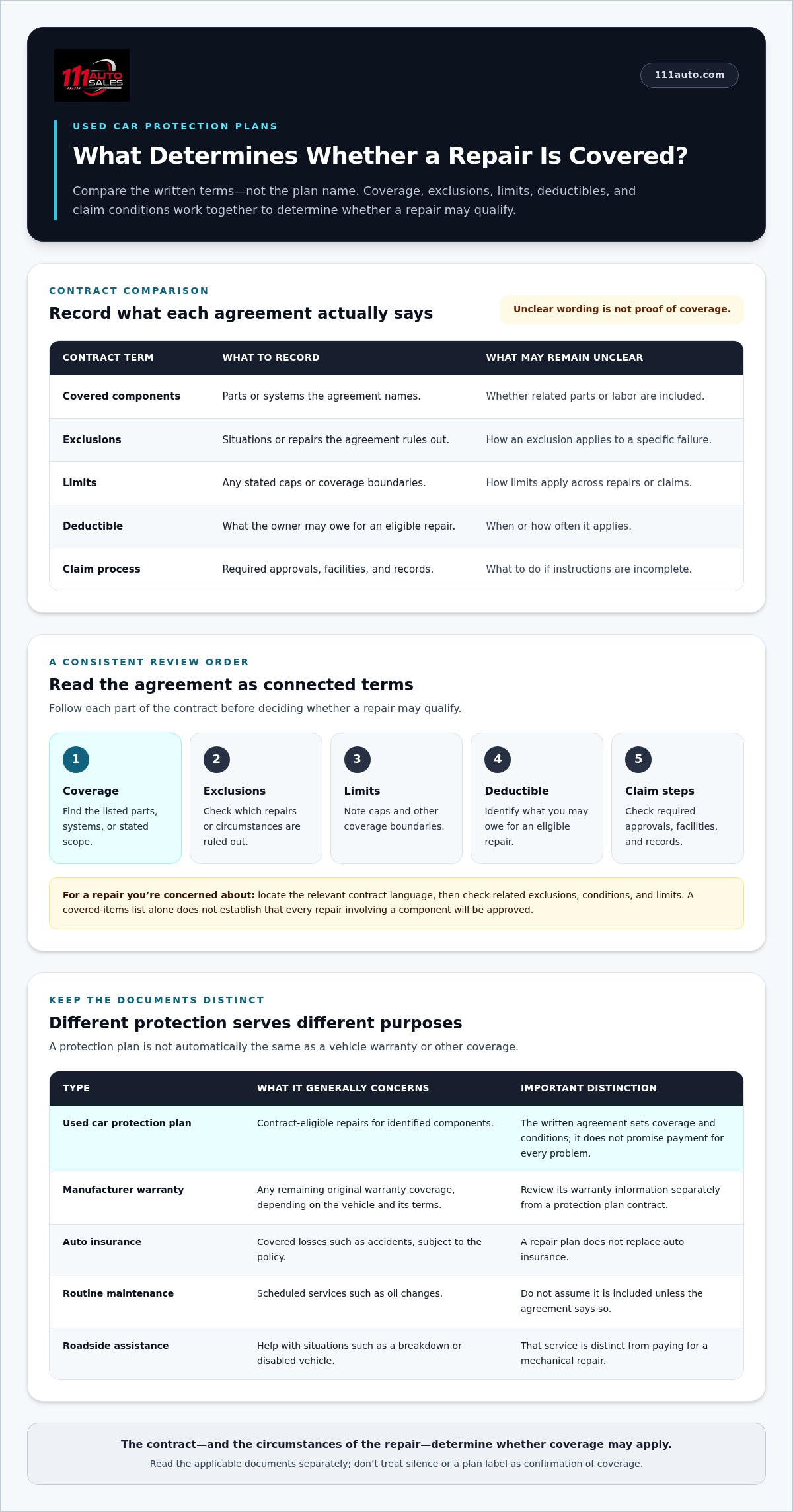
Read the agreement as a set of connected terms, not as a promise attached to a plan name. Start with the coverage section, then review exclusions, payment limits, the deductible, and the claims process. The Consumer Financial Protection Bureau’s explanation of extended warranties also distinguishes vehicle service contracts from other forms of coverage.
A plan’s label alone can’t establish whether a repair is eligible; the written contract and the circumstances of the repair determine that. Use the table below to record what each agreement explicitly says. Mark unclear terms for review rather than treating silence as coverage.
| Contract term | What to record | What may remain unclear |
|---|---|---|
| Covered components | Parts or systems the agreement names | Whether related parts or labor are included |
| Exclusions | Situations or repairs the agreement rules out | How an exclusion applies to a specific failure |
| Limits | Any stated caps or coverage boundaries | How limits apply across repairs or claims |
| Deductible | What the owner may owe for an eligible repair | When or how often it applies |
| Claim process | Required approvals, facilities, and records | What to do if instructions are incomplete |
How do covered components and exclusions affect protection?
Find the section that lists covered parts or describes the scope of coverage. Some agreements name specific components; others use broader wording. Don’t assume broad wording means every part is covered. Read it alongside definitions, exclusions, and limits to understand its reach. If you have a particular repair in mind, identify the contract language that addresses it and note any related exclusions or conditions.
Review any exclusions that address wear, pre-existing conditions, maintenance, or other circumstances, if they appear in the agreement. The wording matters: a general heading doesn’t explain how a specific repair will be treated. These examples are prompts for reviewing a contract, not promises that any particular plan covers or excludes those items.
Why do deductibles and claim procedures matter?
A deductible can reduce the amount paid toward an otherwise eligible repair because you may be responsible for that portion. The agreement determines how it applies. Locate the claim instructions before authorizing work. Check whether the contract describes prior authorization, eligible repair facilities, diagnostic steps, or records to provide. These are points to look for, not claims about a particular plan’s requirements.
Compare each contract using the same table, then resolve unclear wording before relying on it. As you consider protection alongside a vehicle, browse 111 Auto Sales’ pre-owned vehicle inventory in Pontoon Beach.
Are used car protection plans worth it for your vehicle and ownership plans?
Paying for a plan doesn’t guarantee you’ll spend less on repairs overall. You may pay for coverage and still face a repair that falls outside the contract, a deductible, or a claim that doesn’t meet the agreement’s conditions. The practical question is whether the specific coverage offers useful protection for your vehicle and budget during the time you expect to own it.
Start with the vehicle’s age, mileage, known condition, and available maintenance or repair history. These details help frame the risks you’re weighing, but they can’t predict exactly what will fail. Then consider your finances: could you manage an unexpected repair without disrupting other priorities, or would more predictable expenses provide meaningful peace of mind? A plan may help with budgeting when a repair qualifies, but it doesn’t remove every repair cost.
Make the decision for the vehicle in front of you, not for used cars as a category. For a local perspective on how coverage can factor into a purchase, see why a used car warranty matters in Pontoon Beach.
When might additional coverage suit a used-car owner?
Additional coverage may be worth considering if a repair bill would be difficult to absorb at short notice, or if you value a more predictable approach to potential repair expenses. Your planned ownership period matters, too. Coverage may have less practical relevance if you expect to sell the vehicle soon, while a longer ownership plan may make eligible repair protection more relevant. In either case, compare your expected timeframe with the contract’s actual coverage period and conditions.
When might a protection plan be a poor fit?
A plan may fit poorly if its exclusions overlap with the repairs you’re most concerned about, its deductible doesn’t suit your budget, or its claim process feels impractical for how you use the vehicle. The same may be true if you can comfortably handle unexpected repairs and would rather set aside money yourself. Neither choice is right for every owner. Let the agreement and your circumstances guide the decision.
Before deciding, weigh these factors together:
- Vehicle condition: Review what you know about the car’s present state and service history. Don’t treat age or mileage alone as a diagnosis.
- Ownership horizon: Consider how long you plan to keep the vehicle and whether that aligns with the contract’s terms.
- Relevant coverage: Check whether the agreement addresses the repair concerns that matter to you, after accounting for exclusions and limits.
- Out-of-pocket risk: Factor in the deductible and the possibility that a repair won’t qualify for coverage.
- Budget flexibility: Decide whether the plan’s expense or setting aside money for potential repairs better fits your financial priorities.
Compare the plan’s full cost with what you may still owe under its terms, rather than assuming coverage will produce savings. If key terms are unclear, resolve that uncertainty before making the plan part of your purchase decision. A measured choice can be either accepting coverage or declining it. The goal is to understand the trade-off and choose deliberately.
How to compare used car protection plans before choosing one
Compare used car protection plans by lining up contract terms, not plan names or headline descriptions. Two agreements can sound similar while differing in eligibility, exclusions, limits, and claim requirements. Use the same checklist for each option and record what the written agreement actually says.
- Identify the vehicle. Note its year, make, model, mileage, condition, and relevant history. Compare these details with the contract’s eligibility rules.
- Read the coverage. Find the covered components and definitions. Record whether the agreement names particular parts or describes broader coverage, then read the wording closely.
- Check exclusions and limits. Review excluded repairs, coverage caps, and other conditions that could affect whether a repair qualifies.
- Compare costs. Record the plan cost and deductible. Consider what you may still pay for a repair that meets the contract terms.
- Review claims and cancellation. Look for instructions on authorization, repair facilities, required documentation, and cancellation conditions.
What should you check in the written agreement?
Locate the coverage, exclusions, limits, and vehicle eligibility sections. Then record the stated start date, contract term, deductible, and cancellation provisions. Read related definitions and conditions, since a phrase in the coverage section may be narrowed elsewhere. Mark unclear wording rather than filling gaps with assumptions. A plan description can help orient you, but compare the agreements themselves.
Quick comparison worksheet
- Contract and vehicle: ____________________
- Covered components and exclusions: ____________________
- Term and limits: ____________________
- Deductible and total plan cost: ____________________
- Claim steps and cancellation conditions: ____________________
- Unclear terms to resolve: ____________________
Checklist summary: Treat written coverage, exclusions, limits, deductibles, and procedures as verified only when you can point to them in the agreement. Label everything else an assumption until clarified.
How should you match a plan to a used vehicle?
Check the plan’s eligibility rules against the vehicle’s age, mileage, and condition. Compare the agreement’s term with how long you expect to own the vehicle, then consider whether its covered repairs are relevant to your needs. For local truck shoppers, used truck warranty guidance for Pontoon Beach offers a related perspective.
Finish by comparing like with like: the same vehicle details, the same cost categories, and the same contract terms. If you’re shopping for a pre-owned vehicle, explore used vehicles at 111 Auto Sales and include available extended warranty options in your comparison.
Considering a used car protection plan at 111 Auto Sales in Pontoon Beach
For shoppers in Pontoon Beach and nearby communities, a used-car purchase involves more than choosing a body style or comparing vehicles. 111 Auto Sales offers pre-owned cars, trucks, SUVs, and vans, along with extended warranty options. Consider the vehicle and any protection agreement as two related but separate parts of the decision. The dealership serves shoppers in Pontoon Beach, Granite City, Collinsville, St. Louis, Belleville, Maryville, Troy, Alton, Highland, O’Fallon, Glen Carbon, Swansea, and Cahokia.
A plan doesn’t change a vehicle’s condition, repair history, or maintenance needs. Evaluate the vehicle on its own merits, then review the agreement to understand what it may cover. Used car protection plans are contract-based, so don’t rely on a general description to decide whether a particular repair would qualify. The written terms are what you need to assess.
How can you consider coverage alongside a used-car purchase?
Start with the vehicle: consider its age, mileage, condition, and history. Separately, review the agreement’s covered items, exclusions, limits, deductible, eligibility rules, and claim process. Then decide whether the coverage matches your concerns and expected ownership period. Keeping these evaluations distinct helps you avoid treating a protection option as evidence of the vehicle’s condition or as a substitute for understanding its history.
As you compare your options, keep a short set of notes for each vehicle and agreement:
- Vehicle: Record the details and condition you’re evaluating, along with questions about its history.
- Agreement: Note the exact coverage language, exclusions, and limits that affect repairs you’re concerned about.
- Costs and process: Review the deductible, plan cost, claim steps, and cancellation terms in the written documents.
- Ownership plans: Consider how long you expect to keep the vehicle and whether the agreement’s terms fit that timeframe.
For a truck purchase, use the same careful approach. Compare the truck’s details with the agreement’s eligibility conditions, then focus on the contract wording rather than assuming that a broad plan description means every repair is covered. Separating the vehicle assessment from the coverage review makes it easier to weigh the full purchase decision.
What is the next step for local used-car shoppers?
111 Auto Sales is a Pontoon Beach dealership serving local shoppers with pre-owned vehicles and extended warranty options. As you explore vehicles, use your comparison notes to consider the vehicle and available options together, without assuming a plan covers a specific repair unless its written terms say so.
Take a measured next step: Explore used vehicles and protection options at 111 Auto Sales.
Choose coverage with your next vehicle in mind
Before making a decision, write down the vehicle you’re considering, the repair concerns that matter most to you, and the contract terms that address them. Note any costs or conditions you’d still be responsible for. This turns comparison into a practical choice rather than a reflexive add-on or an assumption based on a reassuring plan name.
Used car protection plans are worth considering only when the written terms and the vehicle fit your priorities. You don’t need to predict every future repair. You do need a clear view of the trade-offs and a decision that feels manageable within your budget and ownership plans.
Shoppers in Pontoon Beach and nearby communities can consider the extended warranty options available through 111 Auto Sales alongside its pre-owned vehicles. Explore used vehicles and protection options at 111 Auto Sales.
Bring your comparison notes into your vehicle search. A considered choice can help you start ownership with greater confidence.
Frequently Asked Questions
Is a used car protection plan the same as car insurance?
No. Car insurance and a protection plan address different risks. Insurance may respond to covered events such as a collision, theft, or weather damage, according to the policy. A repair plan may contribute to eligible mechanical repairs under its contract. For example, damage from a crash is generally an insurance question, while a component failure may be a plan question. Read both documents, since neither automatically replaces the other.
Can a used car protection plan cover a pre-existing condition?
It may not, but the contract’s terms and the vehicle’s circumstances determine eligibility. A problem that existed before coverage began could be treated differently from a later failure, so don’t assume the plan will pay for repairs to a known issue. Review the agreement’s eligibility language and note any existing symptoms or diagnosed problems. Understand how the written terms apply before relying on coverage.
Does a used car protection plan cover routine maintenance?
Not necessarily. Routine services such as oil changes, tire rotations, and replacing wear items are different from repairing an eligible failed component. Some agreements may describe maintenance benefits, but don’t assume they’re included in a repair plan. Check the contract for a separate maintenance section and note any service conditions that apply. For example, if you’re budgeting for scheduled brake service, verify whether the agreement addresses it rather than treating it as a covered breakdown.
Are used car protection plans transferable to a new owner?
Sometimes, but transferability depends on the agreement. If you plan to sell the car, look for a clause explaining whether coverage can move to another owner, any required notice or paperwork, and any deadline or fee. Don’t represent the plan as transferable in a private sale until you’ve read those terms. A clear understanding can help you describe the vehicle accurately and avoid promising a future buyer coverage that may not transfer.
When does coverage from a used car protection plan begin?
The agreement’s start date determines when coverage begins, and the contract may also specify conditions or a waiting period. Check whether the effective date is tied to the purchase date, another date, or a stated event. For shoppers in Pontoon Beach, keep a copy of the signed agreement and note its start date with the vehicle paperwork. Don’t assume a repair is eligible simply because it happens after you buy the car.
What happens if a repair is not approved under a protection plan?
If a repair isn’t approved, you may have to pay for it yourself unless the contract provides a review process and the decision changes. Request the reason and compare it with the agreement’s coverage, exclusions, and claim instructions. Keep relevant diagnostic reports, estimates, and communications together. If the contract describes an appeal or reconsideration procedure, follow its steps and deadlines before authorizing work you expect the plan to pay for.
Can you cancel a used car protection plan after buying it?
Possibly. Cancellation rights, required steps, deadlines, and any refund calculation depend on the agreement and applicable terms. Find the cancellation section before signing, then keep the instructions with your purchase documents. If you decide to cancel later, follow the stated process and retain proof of your request. Don’t assume cancellation automatically removes any amount connected with the plan from a vehicle financing arrangement; review your documents to understand how they relate.
Do used car protection plans cover every mechanical breakdown?
No. Used car protection plans cover only repairs that meet the agreement’s terms. A breakdown may fall outside coverage because the affected part isn’t included, an exclusion applies, a limit is reached, or a claim condition wasn’t met. Before assuming a repair will be paid, compare the diagnosis with the contract language and required claim steps. Coverage can vary by agreement, so a broad plan name alone can’t establish eligibility.


