

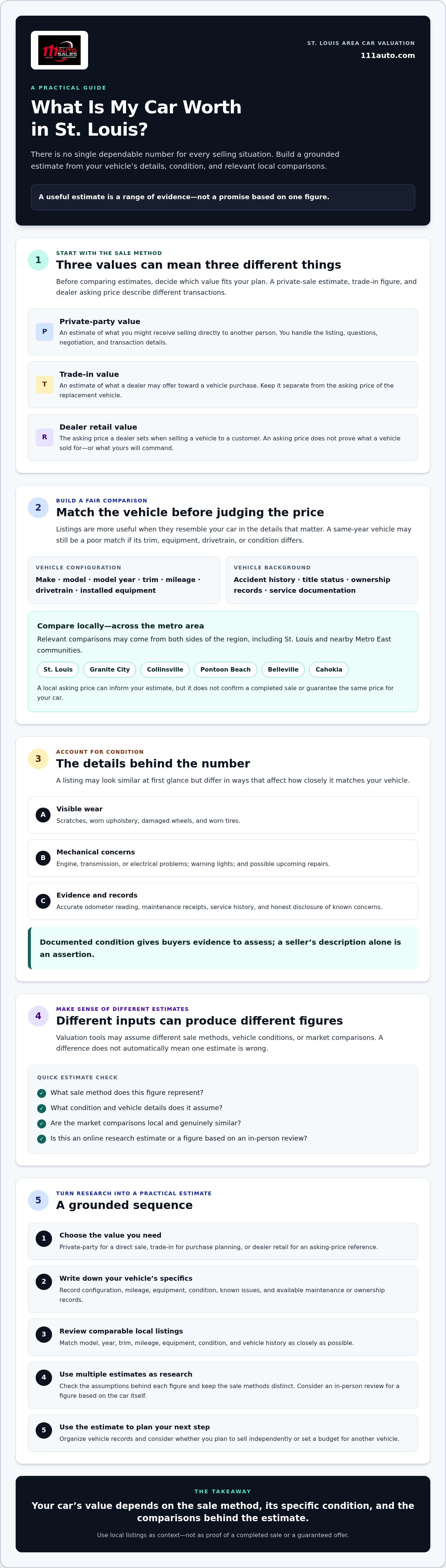
Two online estimates for the same car can both seem plausible, yet neither may tell you what a buyer in St. Louis might actually pay. That’s why “what is my car worth St Louis” rarely has one dependable answer. A national estimate can be a useful starting point, but it may not reflect your car’s condition or local comparisons.
Valuation tools can show different figures because they may assume different sale methods, vehicle conditions, or market comparisons. Mileage, maintenance records, accident history, and cosmetic or mechanical issues can also affect a realistic estimate. It’s reasonable to want more than a number without an explanation.
This guide will help you build a practical value range using your vehicle’s details and relevant St. Louis-area comparisons. You’ll learn how trade-in, private-party, and retail values differ, which valuation method fits your plans, and what to consider next. The goal is a grounded estimate, not a promise based on one figure.
Key Takeaways
- “What is my car worth St Louis” depends partly on whether you’re considering a private sale, a trade-in, or a dealer’s retail price.
- Compare vehicles with similar models, years, trims, mileage, and equipment to make local listings more useful.
- Account for mechanical issues, cosmetic wear, tires, and warning lights when judging how closely a listing matches your car.
- Valuation tools use different inputs and assumptions, so check what each estimate represents before relying on it.
- Use your estimate to organize vehicle records and consider your next step, whether selling independently or setting a budget for another vehicle.
What Does “What Is My Car Worth St Louis” Mean?
A car doesn’t have one universal value for every selling situation. The amount a private buyer might pay, a dealer might offer as a trade-in, and a dealer might ask on its lot can all differ. So when you ask, “what is my car worth St Louis,” first decide which kind of value you need.
Car value is an estimate of what a vehicle may be worth for a specific sale method, given its condition and the market it’s being compared with. That distinction matters: comparing a private-sale estimate with a trade-in figure can make two reasonable numbers look inconsistent. The Car valuation process also considers that value depends on more than a vehicle’s make and model.
Private-party, trade-in, and retail values compared
Private-party value estimates what you might receive by selling directly to another person. You handle the listing, questions, negotiation, and transaction details. Trade-in value is an estimate of what a dealer may offer toward a vehicle purchase, while dealer retail value is the asking price a dealer sets when selling a vehicle to a customer.
These figures can differ because each transaction involves different responsibilities and expectations. A private seller may need to prepare the car and spend time finding a buyer. A retail listing reflects a dealer’s asking price, not necessarily the amount a seller would receive. An online estimate is a research starting point, not a guaranteed offer. The actual figure can depend on an in-person review and the details provided.
Which value should a St. Louis-area owner use?
If you plan to sell directly, focus on private-party estimates and listings for comparable vehicles. If you’re replacing your car, a trade-in estimate can help with planning, but keep it separate from the asking price of the vehicle you’re considering. Compare vehicles in the area where you expect a buyer to shop, rather than relying only on a broad national figure.
Your comparison area may cross state lines. Pontoon Beach is in Illinois, within the wider St. Louis metro area, so relevant listings may come from both sides of the region. Consider vehicles advertised in nearby communities such as Granite City, Collinsville, Belleville, and Cahokia, as well as St. Louis. A local asking price can inform your estimate, but it doesn’t prove that a vehicle sold for that amount or that yours will command the same figure.
What Factors Determine Your Car’s Value in St. Louis?
A useful comparison starts with the vehicle’s exact configuration. Make, model, model year, trim, mileage, drivetrain, and installed equipment help determine which listings are genuinely comparable. Two SUVs from the same year may differ in features and buyer interest if one has a higher trim or a different drivetrain.
Condition adds another layer. Scratches, worn upholstery, and damaged wheels are visible concerns. Engine, transmission, or electrical problems may be less obvious but can still affect a buyer’s confidence. Worn tires and warning lights may prompt questions about upcoming repairs. Accident history, title status, ownership records, and service documentation also help explain a vehicle’s background.
Condition, mileage, and service history
Note the accurate odometer reading and gather service receipts before describing your vehicle. Records can support claims about maintenance, while a general description gives buyers little evidence. Documented condition gives buyers evidence to assess; a seller’s description alone is an assertion.
Disclose known concerns honestly. If you’re unsure what a noise or dashboard warning means, consider a professional inspection rather than guessing. The Federal Trade Commission’s consumer protection advice also discusses used-car research and independent mechanical inspections.
Equipment, demand, and St. Louis-area comparisons
Compare matching trims and drivetrains where possible. A listing for a base-model SUV may not be a sound reference for a higher-trim version with different equipment. Review relevant listings in St. Louis and nearby Metro East communities, including Granite City, Collinsville, Pontoon Beach, and Belleville. Check mileage, condition, and vehicle history. Differences between listings can help explain why apparently similar cars are priced differently.
Local demand and seasonality may influence buyer interest, but don’t assume they create a fixed increase or decrease in value. Check current comparisons rather than applying a guaranteed adjustment. This makes “what is my car worth St Louis” a more grounded question, with an answer based on the specific vehicle and evidence about its condition.
If you’re also considering a replacement vehicle, explore pre-owned vehicle options from 111 Auto Sales LLC as one part of planning your next-vehicle budget.
How to Estimate Your Car’s Value Around St. Louis
Build an estimate in stages instead of relying on a single calculator. Compare figures that use the same sale method and accurately describe your vehicle, then check whether similar cars are advertised in the area.
Gather accurate details before using valuation tools
Before you start, find the VIN, model year, exact trim, current mileage, drivetrain, and installed options. Check your records or vehicle documents if you’re unsure of the configuration. Enter the condition honestly, including known mechanical or cosmetic issues. Selecting the wrong trim, for example, can make an estimate less useful.
Use independent reference tools such as Kelley Blue Book, Edmunds, and J.D. Power, and verify that each currently offers a valuation tool for your vehicle. Choose the value category that fits your plan: private-party estimates if you expect to sell directly, or trade-in estimates if you’re considering replacing the car through a dealer. Don’t compare unlike categories as though they were the same type of offer.
Compare estimates and local listings
Follow this workflow:
- Identify the vehicle: Confirm the VIN, year, make, model, trim, drivetrain, mileage, and equipment.
- Select the valuation type: Match the tool’s category to how you may sell or replace the vehicle.
- Compare independent estimates: Enter consistent details in each available tool. Note the value type and condition assumptions behind each result.
- Check local listings: Search St. Louis and relevant Metro East communities for closely matched vehicles.
For local comparisons, narrow listings by year, make, model, trim, mileage, and condition. Include vehicles on both sides of the metro if those are places a likely buyer might shop, but don’t assume Illinois and Missouri listings reflect identical market conditions. Record a reasonable range and note differences such as equipment, service or accident history, and whether the seller is a private owner or dealer.
Advertised prices show what sellers are asking, not what buyers ultimately paid. Treat them as evidence of current expectations, not confirmed sale values. If a listing is substantially different from your car, identify why before using it as a benchmark.
For a more grounded answer to “what is my car worth St Louis,” compare multiple independent estimates with similar local listings before deciding on a price or next step. Keep your inputs consistent, and revisit the comparison if you discover an important detail about your car’s trim, condition, or history.
Why Car Value Estimates Differ and How to Judge Them
Different estimates are normal. Valuation tools may draw on different data, cover different markets, and make different assumptions about sale type and vehicle condition. One estimate may reflect a private-party sale, while another is closer to a trade-in figure. A difference doesn’t automatically mean one tool is wrong.
Compare what each number represents before deciding what to make of it. An advertised asking price is a seller’s expectation. An estimated value is a calculation based on the information and assumptions behind a tool. A buyer’s confirmed offer is specific to that buyer, vehicle, and transaction. These figures aren’t interchangeable, and none guarantees the amount you’ll receive.
How valuation sources calculate different numbers
Coverage and assumptions can vary by source, including how closely the data reflects your location, vehicle condition, mileage, and intended sale method. Don’t assume a tool uses a particular proprietary formula unless the source explains it. If an estimate seems unusually high or low, first check that you entered the correct trim, drivetrain, mileage, equipment, and condition.
| Valuation source | Sale type represented | Vehicle inputs to check | Estimate limitation |
|---|---|---|---|
| Online valuation tool | May provide private-party, trade-in, or other categories | Year, trim, mileage, equipment, and condition | Reflects the tool’s data and assumptions, not a guaranteed offer |
| Local vehicle listing | Private seller or dealer asking price | Model, configuration, mileage, history, and condition | Shows an advertised price, not a confirmed sale amount |
| Buyer’s offer | A specific proposed transaction | Vehicle details and any inspection findings | Applies to that buyer and transaction; it isn’t a universal market value |
When to get an inspection or professional opinion
If a mechanical concern could affect buyer confidence, an independent inspection can help clarify the vehicle’s condition. It may also help you judge whether an estimate based on your description is realistic. Keep the findings and service records with your other vehicle documents.
For questions about title status, an outstanding lien, or paperwork involving Illinois and Missouri, check with the appropriate state authority or a qualified professional. Requirements can depend on the details, so don’t treat a general online estimate as legal or tax guidance.
For a grounded answer to “what is my car worth St Louis,” compare estimates on equal terms, then weigh them against relevant local listings and your vehicle’s verified condition. If you’re considering a replacement, explore pre-owned vehicle options as you plan your next-vehicle budget.
What to Do After You Estimate Your Car’s Value
Use your estimate to set a planning range, not to assume a particular sale outcome. If you’re selling independently, consider the time you’ll spend preparing the car, responding to buyers, and completing the transaction. If you’re replacing it, weigh your expected proceeds against the budget for your next vehicle. An estimate is a planning tool, not guaranteed money toward a purchase.
Prepare for a sale or replacement decision
Gather the title, service records, ownership details, all keys, and an accurate description of the vehicle’s condition. If there’s an outstanding loan, contact your lender to understand what information or steps may be needed. Keeping these details organized can make it easier to prepare for a private sale or plan a replacement.
Build your next-vehicle budget around more than the estimated proceeds. Consider insurance, registration, and, if you plan to borrow, the financing terms and approval requirements. Avoid committing based on a projected monthly payment or value alone.
Explore used vehicles and financing near St. Louis
Choosing a replacement is separate from selling your current car. 111 Auto Sales LLC is a used-vehicle dealership in Pontoon Beach, Illinois, serving the St. Louis region. Its offerings include pre-owned sedans, SUVs, trucks, and vans, plus vehicle financing and optional extended warranties. If you’re considering a sedan, this guide to used sedan financing in Pontoon Beach may help you prepare questions about financing. Terms and approval depend on the specific transaction.
As you compare your options, explore used vehicles and financing options from 111 Auto Sales LLC.
Use Your Estimate to Plan the Next Move
Once you’ve built a realistic value range, use it to choose a path rather than chase a single number. Decide whether selling independently or planning a replacement better fits your priorities, then set a budget that accounts for the costs and terms relevant to your situation.
If a replacement is on your mind, 111 Auto Sales LLC in Pontoon Beach serves the St. Louis region with pre-owned sedans, SUVs, trucks, and vans. Vehicle financing and optional extended warranties are available. The dealership also focuses on vehicles under $10,000, but confirm current inventory and availability before making plans.
Explore used vehicles and financing options at your own pace. With a clear estimate and a practical budget, you can move forward with greater confidence.
Frequently Asked Questions
How can I find out what my car is worth in St. Louis?
Compare estimates that match your intended sale method, then check listings for similar vehicles in your likely shopping area. Enter the exact year, trim, mileage, drivetrain, equipment, and condition in each tool. For “what is my car worth St Louis,” local comparisons may include Pontoon Beach, Granite City, Collinsville, St. Louis, Belleville, Maryville, Troy, Alton, Highland, O’Fallon, Glen Carbon, Swansea, and Cahokia. Treat asking prices as reference points, not completed-sale results.
Are online car value estimates accurate?
Online estimates can provide a useful starting point, but they aren’t guaranteed offers or exact predictions of sale proceeds. Results depend on the information entered and the tool’s data, assumptions, and valuation category. Check that the vehicle’s trim, mileage, drivetrain, equipment, and condition are accurate. Then compare estimates from more than one source and review relevant local listings. A buyer’s offer may differ after considering the specific vehicle and transaction.
What is the difference between trade-in value and private-party value?
Private-party value estimates what you might receive by selling directly to another individual. You’ll generally manage the listing, buyer questions, negotiation, and transaction details yourself. Trade-in value refers to an estimate a dealer may offer toward a vehicle purchase. The figures can differ because the sale methods involve different effort and responsibilities. If you’re selling independently, compare private-party references; if replacing your car, use trade-in estimates for planning.
Does mileage or condition affect what my car is worth more?
There’s no universal answer; the impact depends on the vehicle and its specific condition. Mileage helps distinguish otherwise similar cars, while mechanical problems, accident history, title status, or worn tires can affect buyer confidence. A lower-mileage car with a serious issue may not compare favorably with a well-maintained higher-mileage example. Enter accurate mileage and describe known issues honestly. Service records and an inspection can provide helpful context when condition is unclear.
Can I use a dealer’s asking price to estimate my car’s value?
Use dealer asking prices as comparison points, not as a direct estimate of what your car would sell for. A retail listing is the seller’s advertised expectation; it isn’t evidence of the final sale amount or a private buyer’s offer. Look for vehicles with a similar year, make, model, trim, mileage, equipment, and condition. Also account for seller type and vehicle history before deciding whether a listing is relevant to your estimate.
How often should I check my car’s value?
Check when you’re seriously considering selling or replacing the vehicle, and update the estimate if important details change. A rise in mileage, a repair, new damage, or a change in documented service history can affect how closely earlier comparisons fit. If you’re only planning ahead, there’s no need to treat the number as fixed. Recheck with accurate vehicle details and current local comparisons before making a decision.
Does 111 Auto Sales LLC buy cars or provide trade-in appraisals?
111 Auto Sales LLC’s confirmed offerings include pre-owned sedans, SUVs, trucks, and vans, vehicle financing, and optional extended warranties. Buying customer vehicles and providing trade-in appraisals aren’t confirmed services, so don’t assume the dealership offers them. The dealership is in Pontoon Beach, Illinois, and serves customers across the St. Louis region. Contact the business directly to clarify any service questions, and explore its used-vehicle selection if you’re shopping for your next car.


